Table of contents : CLICK HERE !

Saturday, July 29, 2017

Café Schimmel

Photo Café


Excerpt from the novel "Berlin-Expo".


"The Schimmel was the meeting place of the review Der Bruch; None of them had neither the space nor the comfort to receive. In addition, they preferred a public place, to feel in the midst of the hustle and bustle of the city. The Schimmel also had the advantage of being close to other Westend meeting places.


Recently redecorated in a style that Paul called "art-deco" but which according to Heinz was a late "art-nouveau" and which Harry defined as "Bastard of viennese café and cocktail bar", the establishment had two parts at different levels, clearly circumscribed by a balustrade or metal grille, crowned by a wooden railing. The large columns, which divided the room into smaller spaces, made it appear larger than it was.

Each section had its clientele. The level at the bottom, closest to the entrance, was favored by the elegant ladies. The newcomers to the cafe also tended to settle there, no doubt because they were the first tables they met on entering.

The regulars preferred "the parterre". For the conversation, it was quieter and from there they had a view over the whole place.

Table eighteen, where Harry and his band sat, was known by the waiters as "the table of philosophers." There was also "the teacher's table", just by the railing.

The only one of the group that was actually a professor was an old gentleman who had taught history in high school. But there was also a certain Gregorius, who called himself a professor and whose specialty was "experimental astrology". He usually leaned on the grid to better observe the tables from below. Another regular at the table was a retired colonel with thick white mustaches and monarchist ideas.

But if the Der Bruch team spent much of their time at the cafe, they had little contact with the staff. Not by class prejudice but because they did not feel quite welcome. Perhaps because, always mowed, they left little or no tip. Harry had made this necessity virtue: "Tipping makes of the client a lord and of the server a serf, it is a feudal remain."

Vittorio was the only one who bothered to interact with the staff. Since he did not belong to the group strictly speaking, he was free to wander around the room. He came every other night, arrived about nine o'clock, and shortly after ten o'clock he set out again. To the Romanisches. He came to the Schimmel because he liked the young people of Der Bruch, but to maintain and enrich his social network, the Romanisches was irreplaceable. "
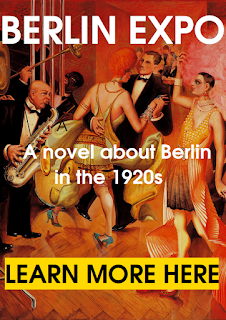


https://www.amazon.com/Berlin-Expo-Jorge-Sexer/dp/1717880525/ref=tmm_pap_title_0?_encoding=UTF8&qid=1539983013&sr=8-1


Friday, July 28, 2017

Romanisches Café

Berlin - Romanisches cafe - 1928


The Romanisches Café was situated in the Breitscheidplatz, about where Europa-Center is today. It opened in 1916. As the old Café des Westens had shut in 1915, it developed into the most important artists' cafe in Berlin, especially after 1918.

The café was a meeting place for the intelligentsia, for the leading writers, painters, actors, directors, journalists and critics of the day. At the same time it became a place for newbies, who would try to start their artistic careers by establishing contacts here. The already established artists, for their part, would group into séparées in an attempt to distinguish themselves from the mass.

Towards the end of the Weimar Republic, as the political situation in Germany became more violent, the Romanisches Café gradually lost its role. As early as 1927 the Nazis instigated a riot on the Kurfürstendamm during which the café, as a meeting place for the left-wing intellectuals they hated, was among the targets of violence. The coming to power of the Nazi Party and the subsequent emigration of most of its regulars signalled the final end of the café as an artists' haunt. The Romanisches Haus was completely destroyed by an Allied air-raid in 1943.


Famous regulars : Bertolt Brecht, Otto Dix, Alfred Döblin, Hanns Eisler, George Grosz, Sylvia von Harden, Erich Kästner, Irmgard Keun, ElseLasker-Schüler, Erich Maria Remarque, Joseph Roth, Ernst Toller, Kurt Tucholsky, Franz Werfel, Billy Wilder.


This is how the writer Erich Kästner maliciously described it in 1928:

"The Romanisches Café is a waiting room for talent. Some people have been waiting for talent here every day for twenty years. They master the art of waiting to an astonishing extent, even if they don’t master anyhing else. (...) It is an infernal mass of Characters and those who want to be Characters. The first impression you have: hair, mane, curls all falling over the face. The second impression: how often do these people wash ?

This second impression may be unjustified in many cases, but the very fact you have it is significant in itself (...) Everyone knows everyone, they greet each other jovially or - another method - casually, in order not to interrupt their brain’s activity with poetry or other thinking. You sit at one table, then at another, first to tell gossip, second to explain to the waiter that you are just sitting there en passant. You read mountains of newspapers. You wait for happiness to step from behind the chair and tell you: "Sir, you are engaged!"

Artists who already have a name also come here. Why do they do it ? A bad habit, maybe. But there are also pathological cases: established artists who consider it a pleasure (and a cup of coffee is not so expensive after all) to look at the crowd of the wretched and the hopeless, while letting themselves be admired. For it is a wave of admiration when a succesful person enters the place. And whoever he greets feels honoured, consecrated …

Can you get an idea of the Romanische if to the preceding description I add that it is also called the ´Rachmonische´ and that besides the mentioned types there are artists, musicians, boxers and negroes sitting around? "


By Erich Kästner, Das Rendezvous der Künstler, Neue Leipziger Zeitung from 26 April 1928.

Today it would be risky to write a bit scornfully about black people and Jews, as Kästner does here in the last paragraph. But then, he was writing one century ago...

And the fact is that Yiddish writers did frequent the Romanisches Café, nicknamed the Rachmonisches ('pitiful' in Yiddish) by its regulars because of its poor food and run-down interior. 


And this is how another writer, the then young Irmgard Keun, saw the place:

"And beyond, is the Romanisches Café where men have so long hair! And there I spent the evenings with the cultural elite, which means a selection of the best (but every crossword-solver knows that). And we formed like a coterie the whole bundle, and the Romanisches Cafe is unrecognizable nowadays. And everyone says now: Lord, that place where all those penniless writers sit, you cannot go there anymore. But they go there. I learned a lot, it was like teaching yourself a foreign language. And none of them has much money, but they live in any case, and some of the elite play chess instead of having money. And it takes a lot of time, that's the point of it all, but the waiters don’t see it that way, because a cup of coffee brings a tip of five pfennig and it's not much from a chess-guest who sits there for seven hours."
By Irmgard Keun, "The artificial silk girl", 1932 


https://www.amazon.com/Berlin-Expo-Jorge-Sexer/dp/1717880525/ref=tmm_pap_title_0?_encoding=UTF8&qid=1539983013&sr=8-1


Tuesday, July 25, 2017

Berlin's Eiffel tower

Berlin Brandenburg Gate 1928


The Brandenburg Gate, a symbol of Berlin, was erected in 1791. It is crowned by a quadriga, the work of Johann Gottfried Schadow, representing the goddess of victory in a chariot pulled by four horses.

 In 1806, Napoleon took the quadriga with him, to decorate the triumphal arch of the Carrousel in Paris. But finally he preferred the Venice horses he had stolen from St. Mark's Basilica during the Italian Campaign. Unused, the Berliner quadriga will remain eight years in Paris, admired by no one because it was locked up in boxes.

In 1814, after Waterloo, the quadriga returned to Berlin in triumph.

Enclosed by the wall, the Brandenburg Gate was inaccessible to Berliners both from the West and from the East, as it was in the middle of the no man's land which separated the two parts of the city. Ttherefore it became the symbol of the division of Berlin.

The gate is now represented on the German coins of fifty centimes of euro and others, as a symbol of the recovered unity.


The picture was taken in 1925.


https://www.amazon.com/Berlin-Expo-Jorge-Sexer/dp/1717880525/ref=tmm_pap_title_0?_encoding=UTF8&qid=1539983013&sr=8-1


Sunday, July 23, 2017

Berlin: a moveable feast

Berlin party 1928

Berliners were known for their love of feast and spree. On summer holidays, the favorite plan was to go swimming at the lakes or take a walk in the woods of Grunewald. But when the night came, the woods and lakes became peaceful again and it was the restaurants and cabarets "with guaranteed good atmosphere" that assumed the main role.
The inhabitants of the capital demanded entertainment and amused themselves frantically, but at the same time conscientiously, taking advantage of every opportunity to have a good time, just as at work they used each hour in the most rational way.
And it was not difficult to be entertained: the ‘revues’ of Erik Charell had little to envy the Folies Bergères and the "risky" shows went beyond the most daring of Parisian scenes.

From "Berlin-Expo", novel available on Amazon.


https://www.amazon.com/Berlin-Expo-Jorge-Sexer/dp/1717880525/ref=tmm_pap_title_0?_encoding=UTF8&qid=1539983013&sr=8-1


Tuesday, July 18, 2017

Harmony or disharmony?

Berlin Friedrichstrasse 1926


Notes by Gaston Morel, a French art dealer who visits the city two or three times a year, from 1929 to 1933:

"Berlin is the opposite of a harmonious city; It is made up of disagreements and dissonances. The effervescence of Alexanderplatz against the calm of the residential districts. The bucolic Tiergarten and, close by, the feverish movement of Potsdamer Platz, the largest traffic node in Europe.
It is cosmopolitan and provincial. Cosmopolitan ? Actually, there are not so many foreigners here, two out of a hundred, no more. Russians fugitives from communism, but also Poles, Czechs, Hungarians, Swiss, Swedes, people from all the Balkans. And
a few Englishmen, attracted by the depreciated mark and the rich and varied sexual offer.
Cosmopolitan nevertheless, less by its population than by the circulation of ideas: this city
is quick to adopt the latest trend, whether it comes from Paris, Chicago or Moscow. She fears, above all, not to be up to date with the latest fashion. A little snobs the dear Berliners, perhaps because this city does not have the traditions of Paris or Rome, because it is an upstart among European capitals.
German cities with tradition are Munich, Cologne, Frankfurt, and also Vienna. Ex-sieges of the Holy Roman Empire, the Aulic Council, the Imperial Diet. Berlin is a recent capital city.
Most palaces and ministries, museums and faculties, were built when the city became the center of the German Empire. Before that, it was only a regional capital.
That is precisely why she is so impatient to become something today. To become, if possible, everything.
My visits to Berlin are an injection of adrenaline. The rhythm of the city transmitt
s to me, and I feel this tension, a positive tension, still weeks after coming back to Paris. "


(from Berlin-Expo)


https://www.amazon.com/Berlin-Expo-Jorge-Sexer/dp/1717880525/ref=tmm_pap_title_0?_encoding=UTF8&qid=1539983013&sr=8-1


Sunday, July 16, 2017

Weimar = inflation

Bank notes Weimar Germany

The "golden twenties were also the years of the hyperinflation in Germany, especially between 1921 and 1924, and more dramatically the year 1923, when prices rose ridiculously rapidly from day to day and even from hour to hour.

I knew a gentleman who lived these years in Cologne. He told me of a day when he was sent to the hairdresser with a bundle of notes to pay for his haircut. But the shop was just closing. So he came back in the afternoon to learn that his bundle wasn't enough any more. The cut, which cost ten millions of marks before noon, now demanded twelve millions. And at the moment of closing the shop, the price had reached fourteen millions.


Bank notes Weimar Germany
Museum of the city of Baden-Baden


https://www.amazon.com/Berlin-Expo-Jorge-Sexer/dp/1717880525/ref=tmm_pap_title_0?_encoding=UTF8&qid=1539983013&sr=8-1


Tuesday, July 11, 2017

The marshal

Marshal Hindenburg


April 1925, campaign for the presidential elections. The statue, in cardboard-stone, depicts Marshal Hindenburg, a former monarchist and chief of staff of the German army during the First World War.

The photo is taken in the Tauentzienstrasse, only meters from the Kurfürstendamm and the Gedächtniskirche, in the heart of West Berlin.

Hindenburg was elected president. Hitler did not deem himself strong enough to stand for election. The man in uniform in the seat of the truck is branding a red-white-black flag, the imperial flag (the Weimar Republic adopted the black-red-yellow, the same as the current one).


Germany historical flags


https://www.amazon.com/Berlin-Expo-Jorge-Sexer/dp/1717880525/ref=tmm_pap_title_0?_encoding=UTF8&qid=1539983013&sr=8-1


Sunday, July 9, 2017

Election day

Election day Berlin 1932


The Weimar Republic was the first democratic regime in Germany. Already under the Kaiser there was a parliament, but it was the emperor who ultimately decided, especially in matters of foreign policy.

The photo shows sandwich-men at the entrance of a polling station during the second round of the 1932 presidential election. Strict equality: two for Marshal Hindenburg, two for the communist Thälmann, two for Hitler. Who won? Hindenburg, 53%, ahead of Hitler, 36% and Thälmann, 10%. No candidate of the powerful Social-Democratic party, which supported Hindenburg in order to block the Nazis. Note that in the first round, 0.6% of the voters had chosen the candidate of the Party of Victims of Inflation ...


https://www.amazon.com/Berlin-Expo-Jorge-Sexer/dp/1717880525/ref=tmm_pap_title_0?_encoding=UTF8&qid=1539983013&sr=8-1


Thursday, July 6, 2017

Berlin, the german capital


Map German Empire
The German Empire
Berlin became the capital of the German Empire in 1871. At that time, as can be seen in the map, the city was in a central position, in the heart of Germany.

The red line marks, approximately, the present boundary, the parts to the East having gone to Poland and other countries. Today, Berlin is quite off-center in the German context.

Moreover, it can be seen that Berlin was closer to Poland and Czechoslovakia than to France or the Netherlands. Not quite a city of the East, it was not part of Central Europe either (like Vienna was). Neither oriental nor western nor central. "Berlin is located exactly where Berlin is", as an old Berliner phrased it.

Map Weimar Republic
The Weimar Republic


https://www.amazon.com/Berlin-Expo-Jorge-Sexer/dp/1717880525/ref=tmm_pap_title_0?_encoding=UTF8&qid=1539983013&sr=8-1


Potsdamerplatz, Berlin

Berlin - Potsdamer Platz- 1926


The Potsdamer Platz was, in 1930, the largest traffic node in Europe. The first traffic lights (of the world?) Were installed in this square. Several tram lines, plus the lines 1 and 2 of the U-bahn, had their stops here. This square was the symbol of the dynamism of the city. Berlin was one of the most populous cities in the world at the time. But then the war came, and the population of Berlin is less important today than in 1930.

More, much more about Potsdamer Platz here: 

http://www.weimarberlin.com/2021/08/potsdamer-platz.html


https://www.amazon.com/Berlin-Expo-Jorge-Sexer/dp/1717880525/ref=tmm_pap_title_0?_encoding=UTF8&qid=1539983013&sr=8-1


Wednesday, July 5, 2017

Map Berlin 1930

Berlin in 1930. The Weimar-republic has yet 3 years to live.

Monday, July 3, 2017

Why a Berlin blog?

Berlin Photo Potsdamerplatz 1930


Why a Berlin blog? No explanation, needed, I think. Berlin is one of the most dynamic and vibrant cities in Europe. Many young people dream of moving there.

But Weimar? Why on earth ? Weimar is one city, Berlin another. Three hundred kilometers separate them. Why then Weimar? What’s this talk about Weimar-Berlin? Well, because it was in Weimar that the Constituent Assembly met in 1918, after the defeat of the German Empire, to promulgate a constitution for what would be the first German republic.

When we speak of Germany in Weimar, or, as here, of Weimar Berlin, we speak not so much of a form of government, but above all of an epoch: the period 1918 -1933. The twenties, which some think "golden". And so they were, but they were also years of conflict, often bloody. And, in the German case, they were the time of great misery, inflation which added zeros every day to the price of bread. The Weimar years begin with defeat, which soon turns into turmoil. A Communist revolution met with pitiless repression, para-military bands that kidnapped, killed political enemies. But at the same time, an abundance of artistic creativity, painting, literature, theater and cinema. And a lifestyle, carefree for some, a gaiety of life that was expressed mostly at night. The Berlin-nights. The cabarets. We think of Marlene Dietrich and her blue angel. And also, closer to us, to Liza Minnelli, in the 70s film. I will share with the readers of this blog, not my memories, I am not old enough to have experienced this time but my readings, my conversations. As well as photos, links to movies, songs.

Auf wiedersehen, then!