Table of contents : CLICK HERE !

Wednesday, June 27, 2018

Leo Monosson, a crooner in Weimar Berlin

Singer Leo Monosson
The immensely popular crooner Leo Monosson was born 1897 in Moscow, to a wealthy family. He completed his schooling in Russia and thought for some time of making a literary career. He even published a poetry book in 1918. Then he left for Warsaw, Paris and Vienna, where he studied music and singing before settling in Berlin in 1923.

Leo was fluent in more than ten languages, including Chinese and Japanese, and had an exceptional memory for lyrics and songs. He was an enormously successful performer, credited with around 1500 recordings. He was even known under pseudonyms like Leo Minor, Leo Emm, Leo Frey, Leo Moll, Leo Moon, and Leo Frank, Fred Mossner and Léon Monosson.

One of his most popular recordings was « Liebling, mein Herz lässt dich grüßen », with Ben Berlin’s orchestra.

He dubbed a number of screen actors before starting a film- career for himself. His first major role was in the hugely successful comedy “Die Drei von der Tankstelle” (The Three from the Filling Station) from 1930, where he sings the leading theme of the production: « Ein Freund, ein guter Freund » as well as «Halloh ! Du süsse Frau». Both can be heard in Youtube. 

German 1930 Film Die 3 von der Tankstelle


As Léon Monosson, he made some recordings in France with the great guitar player Django Reinhardt. 

He starred in 11 major films before he was forced to emigrate. When the Nazis came to power, Leo, as a Jew, was forbidden to record or perform and so had no choice but to leave for France. But when he in 1940 had to leave Europe altogether, his career came to an end.  He died in 1967 and he is buried near New York.

German 1930 Film Die 3 von der Tankstelle
Lilian Harvey and Willy Fritsch in "Die 3 von der Tankstelle"


https://www.amazon.com/Berlin-Expo-Jorge-Sexer/dp/1717880525/ref=tmm_pap_title_0?_encoding=UTF8&qid=1539983013&sr=8-1


Sunday, June 24, 2018

Lotte Laserstein, German painter in exile

Lotte Laserstein


Lotte Laserstein was born in 1898 in a small town in eastern Prussia, now a part of Poland. When, in 1927, she was the first woman to finish her studies at the Berlin Academy, she was predicted to have a fine career as an artist. That was without counting on National Socialism. Indeed, the Nazis declared that, her origins being partly Jewish, she was banished from all public life.

Berlin in the 1920s was an uneasy yet exciting place. Laserstein painted cadavers to illustrate text books, as a means of surviving during the hyperinflation period. During this time women were becoming more independent, choosing their appearance in a freer manner, often with a masculine accent. Laserstein’s work incorporated a number of metropolitan subjects, such as fashionable Neue Fraus (New women), tennis players, journalists, a motorcycle rider in his leathers, often in urban settings. 


Lotte Laserstein
Painting in her studio


In 1937, the invitation of a Swedish gallery gave Laserstein the opportunity to leave Germany, now under Nazi rule, with a number of her paintings. Six months later, she gets married to obtain Swedish nationality. To survive, she paints mostly commissioned portraits, but also landscapes. Like many other exiles, she suffers from the material and psychological conditions of exile and her work lacks the brilliance of the Berlin years.

She remained outside the avant-garde currents and her style is sober, traditional and realistic, without the cold side of the new objectivism, or without caricature like the Expressionists.

After the Second World War, abstract painting is in vogue, and despite a small breakthrough in the Anglo-Saxon countries in the early 1990s, she remained unknown in Germany, her native country.

She died in 1993.
 
 
Lotte Laserstein


https://www.amazon.com/Berlin-Expo-Jorge-Sexer/dp/1717880525/ref=tmm_pap_title_0?_encoding=UTF8&qid=1539983013&sr=8-1


Thursday, June 21, 2018

Hans Baluschek, the painter or the working class

Hans Baluschek

Hans Baluschek (1870-1935) was a German painter, illustrator and writer. A prominent representative of Critical Realism, he sought to portray the life of the common people. His paintings centered on the working class of Berlin. He belonged to the Berlin Secession movement, a group of artists interested in modern developments in art. Yet during his lifetime he was best known for his illustrations of popular children's books. He was an active member of the Social Democratic Party and belonged to its left wing, close to the communists.


The nazis classified him as a « degenerate artist » and he was forbidden to practice his craft, as was the case of many others painters.


Baluschek doesn’t belong to the best known artists from the 1920s and he was for a long time forgotten. But not in the German Democratic Republic (the communist East Germany), where exhibitions of his works were often staged.
Hans Baluschek
Hans Baluschek

Hans Baluschek


https://www.amazon.com/Berlin-Expo-Jorge-Sexer/dp/1717880525/ref=tmm_pap_title_0?_encoding=UTF8&qid=1539983013&sr=8-1


Monday, June 18, 2018

Gustav Wunderwald, painter of the suburbs


Gustav Wunderwald
Berlin in the 1920s is often associated with excess and decadence, but it is a very different side of the city that interested the painter Gustav Wunderwald (1882-1945).
For a few years, around 1927, Wunderwald's urban landscapes were very popular. Gustav Böss, then mayor of Berlin is among those who bought his paintings. Wunderwald's work consists mainly of landscapes of Berlin and its surroundings. The gray streets of popular neighborhoods are as often represented as the cleaner, more airy streets of the west end of the city.

It is for his paintings of the working-class districts of Berlin that Wunderwald is best known, and for the "non-romantic and objective approach" to his subjects, as one art critic put it. Wunderwald has been associated by art historians with the painting style Neue Sachlichkeit (New Objectivity) that emerged during the Weimar Republic.

Despite the destruction of the city during the Second World War, it is still possible to recognize some of the streets that Wunderwald painted in the 1920s, especially in the Wedding district.


Gustav Wunderwald
Gustav Wunderwald


https://www.amazon.com/Berlin-Expo-Jorge-Sexer/dp/1717880525/ref=tmm_pap_title_0?_encoding=UTF8&qid=1539983013&sr=8-1


Friday, June 15, 2018

Max Beckmann


Max Beckmann, born in Leipzig in 1884 and died in New York in 1950, lived in Berlin for several years, before going into exile in 1937.
His early works are marked by Berlin Impressionism, but by 1917 his painting expresses a raw verism, reflecting the tragic climate of war. Beckmann rediscovers the original language of German Expressionism: elongated figures, broken limbs, physical and moral suffering, a reflection of the 1914-18 war in which Beckmann participated as a male nurse. Later he adopts a more realistic style, which brought him closer to the current known as neo-objectivist, where Schlichter, Dix and Grosz also appear.
His work shows the social and moral crisis of Germany in the 1920s. Without falling into political propaganda, he clearly shows his opposition to Nazism.


Self-portrait in tuxedo


https://www.amazon.com/Berlin-Expo-Jorge-Sexer/dp/1717880525/ref=tmm_pap_title_0?_encoding=UTF8&qid=1539983013&sr=8-1


Tuesday, June 12, 2018

Lisbet Juel, a talented illustrator

Lisbet Juel - Ulk


Illustrator Lisbet Juel was a regular contributor to Ulk, a weekly supplement of the social-democratic newspaper Berliner Tageblatt of the Mosse publishing house. Ulk also appeared as a supplement to the Berliner Volks-Zeitung. Lisbet Juel worked also in the newspapers Svenska Dagbladet (Stockholm) and Politiken (Copenhagen).
Lisbet Juel was born in Copenhagen (or perhaps in Stockholm) in 1903 to a Swedish mother, the painter Astrid Kjellberg, and a Danish father, the writer Erik Juel. There are few biographical details of this artist.

Here is a link to a blog dedicated to her:


Lisbet Juel - Ulk
Lisbet Juel - Ulk
Lisbet Juel - Ulk
A serious problem: I am invited to King Amanullah (from Afghanistan). Style me so that the hair will not fall on my nose when I bow my head.
Lisbet Juel - Ulk
Lisbet Juel - Ulk


https://www.amazon.com/Berlin-Expo-Jorge-Sexer/dp/1717880525/ref=tmm_pap_title_0?_encoding=UTF8&qid=1539983013&sr=8-1


Saturday, June 9, 2018

Battleship Potemkin, a Berlin success

Potemkin film poster in German

Battleship Potemkin, from 1925, is one of the most famous films in history. Not a German film, mind you, but Berlin played a major role in its commercial success around the world. Apparently Serguei Eisenstein’s production, premiered in December 1925 at the Bolshoi Theater in Moscow, failed to attract widespread acclaim in the USSR, maybe because it was considered too avant-garde for the public.
On January 21st 1926, the Soviet Embassy in Berlin organized a private screening of the film at the Grosses Schauspielhaus, as one of the events to commemorate Lenin's death, two years earlier. Among the public were Richard Pfeiffer and Willi Münzenberg, two of the directors of the small film company Prometheus. Münzenberg had already seen the film at its Moscow premiere. They immediately bought the right to distribute the film in Germany. 
 Miinzenberg asked a distributor in Hamburg to submit the film to the censorship bureau. The censors decided to forbid it, triggering a wave of protests from well-known intellectuals. At last, the film was allowed to show, but Prometheus had trouble finding a theater in Berlin and had at last to accept the offer of a second rate scene, the Apollo Theater. 
Prometheus’ executives invited two internationally famous film stars, none less than Mary Pickford and Douglas Fairbanks, to attend the premiere. Pickford, who was not only a famous actress but would also reveal herself as a film producer, didn’t like to travel, but she did it in order to promote her films in Europe.
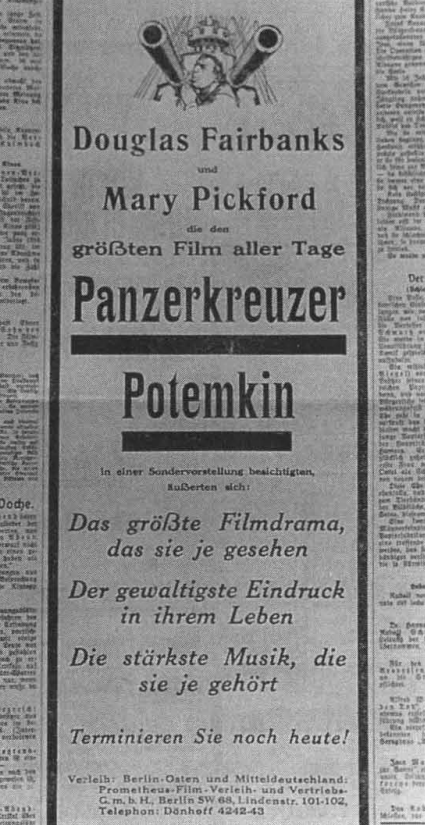
She and Fairbanks, her husband, were greatly impressed by Eisenstein’s film, as this advertisement on the magazine Film-Kurier from May 7th 1926 shows :
Advertising for Potemkin in Berlin


The greatest film drama they have ever seen ! The strongest impression of their lives ! The most powerful music they ever heard ! say Mary and Douglas.


 Douglas Fairbanks and Mary Pickford in a Russian magazine


Apollo Theater was on the southern end of the Friedrichstrasse, in Kreuzberg, far from central Berlin. It had previously been an operetta theater, where another memorable premiere had taken place in 1899 : Frau Luna, by Paul Lincke, one of whose tunes is the famous Berlinerluft, which became in time the unofficial Berlin anthem.
Prometheus asked the composer Edmund Meisel (Vienna 1894- Berlin 1930) to write the music to accompany the film. It was played by a fifteen instruments orchestra. Prometheus even published, and sold, a piano version of Meisel’s score. Meisel composed also the music for Berlin, symphony of a great city, from 1927.
Potemkin’s commercial premiere took place the 29 April 1926. The film was a great success and some consider that it was this initial success that secured the film’s triumphal tour around the world.
Apollo Theater in Berlin
The Apollo Theater


https://www.amazon.com/Berlin-Expo-Jorge-Sexer/dp/1717880525/ref=tmm_pap_title_0?_encoding=UTF8&qid=1539983013&sr=8-1


Wednesday, June 6, 2018

"The red flag"

Babylon Berlin S01E04

A scene from the TV series Babylon Berlin.

Behind Gereon Rath, on the newsstand at Alexanderplatz (episode 4 of the first season) we see a copy of the newspaper Die Rote Fahne. Die Rote Fahne (The Red Flag) was, during the Weimar republic, the organ of Germany’s Communist Party (K.P.D.). It had two daily editions (morning and afternoon) and was sold not only in newsstands but also by party members on the street. It was possible to subscribe on monthly or even weekly (!) basis (these were hard times, especially for workers, and not everybody could cough up 2.60 marks for a whole month’s subscription).

Even if the Fahne had a loyal audience, it was not much compared with another communist paper, Die Welt am Abend, expertly directed by Willi Münzenberg and not officially recognized by the Party. 

The Fahne was forbidden under Hitler. And when Communist East Germany was created after the war, the official paper was not the Fahne but a new one, Neues Deutschland. The reason appears to be that the ruling party in the new state was not the KPD but the SED, a new organization formed by the (forcible) fusion of Communists and Social Democrats. Before the war, the social democratic organ was Vorwärts (Forward). In the new socialistic state, there would be neither Red Flag nor Forward, only New Germany (Neues Deutschland).

The copy we see in the videocaption is dated 1st May 1929. It calls for a worker’sdemonstration, and several episodes of Babylon Berlin revolve around that demonstration and what followed.

On the front page, under the title in Fraktur lettering, we read that the paper was founded by Karl Liebknecht and Rosa Luxemburg (both murdered by extreme-right bands in 1919) and that it is the official organ of the KPD. Between brackets : « Section of the Communist International ». That International (the Third one) was founded in the Soviet Union and better known as the Comintern, responding to Stalin’s orders. The First and Second had been founded in Germany by Marx-Engels and by reformist Socialdemocrats respectively. And the Fourth International was the trotskyite one. There is no Fifth International, as yet.

The thickest title, in Latin (not Fraktur) script reads : Fighting May 1929. And under it : « Radicalization of class contradictions, growing danger for an imperialistic war, dramatic progress of the KPD : all these are forebodings of a new, mighty wave of proletarian revolutions ! »

Several pages are dedicated to attack Karl Zörgiebel, socialdemocratic chief of the Berlin police and one of the secondary characters of Babylon Berlin. 
 
 
From Staatsbibliothek zu Berlin


https://www.amazon.com/Berlin-Expo-Jorge-Sexer/dp/1717880525/ref=tmm_pap_title_0?_encoding=UTF8&qid=1539983013&sr=8-1


Sunday, June 3, 2018

Rudolf Schlichter, friend of Brecht and Grosz

Dada Roof Studio (1922?)

Rudolf Schlichter (1890-1955), who belonged to the Neue Sachlichkeit (New Objectivity) tendency, is less known than his contemporaries George Grosz and Otto Dix.
He studied art in Stuttgart and Karlsruhe. Called to military service during the First World War, he went on a hunger strike to obtain his early release and in 1919, moved to Berlin where he joined the KPD (the Communist Party of Germany) and the Novembergruppe. This group was created as a result of the defeat of the German Revolution of 1918-19. The artists of the Group belonged to the avant-garde. They held 19 exhibitions in Berlin until the group was banned by the Nazi regime. Its members were not exclusively plastic artists; the playwright Bertolt Brecht, the composer Kurt Weill and the architect Walter Gropius were also part of it.

In 1920, Schlichter participated in the Dada movement and also worked as an illustrator for several newspapers, including Der Querschnitt and Arbeiter Illustrierte Zeitung. In 1924, with John Heartfield and George Grosz, he created the Rote Gruppe, which brought together artists linked to the Communist Party. A major work of this period, Dada Roof Studio, a watercolor showing a strange mixture of characters and models on a roof, reflects the influence of De Chirico and metaphysical painting.

In 1925, Schlichter participated in the Neue Sachlichkeit exhibition in Mannheim. His work from this period is realistic. But the arrival of the Nazis to power marks the end of the artistic career of Schlichter, labeled "degenerate artist". He resumed painting after the war, and died in 1955.


Portrait of B.Brecht (1926)


https://www.amazon.com/Berlin-Expo-Jorge-Sexer/dp/1717880525/ref=tmm_pap_title_0?_encoding=UTF8&qid=1539983013&sr=8-1